
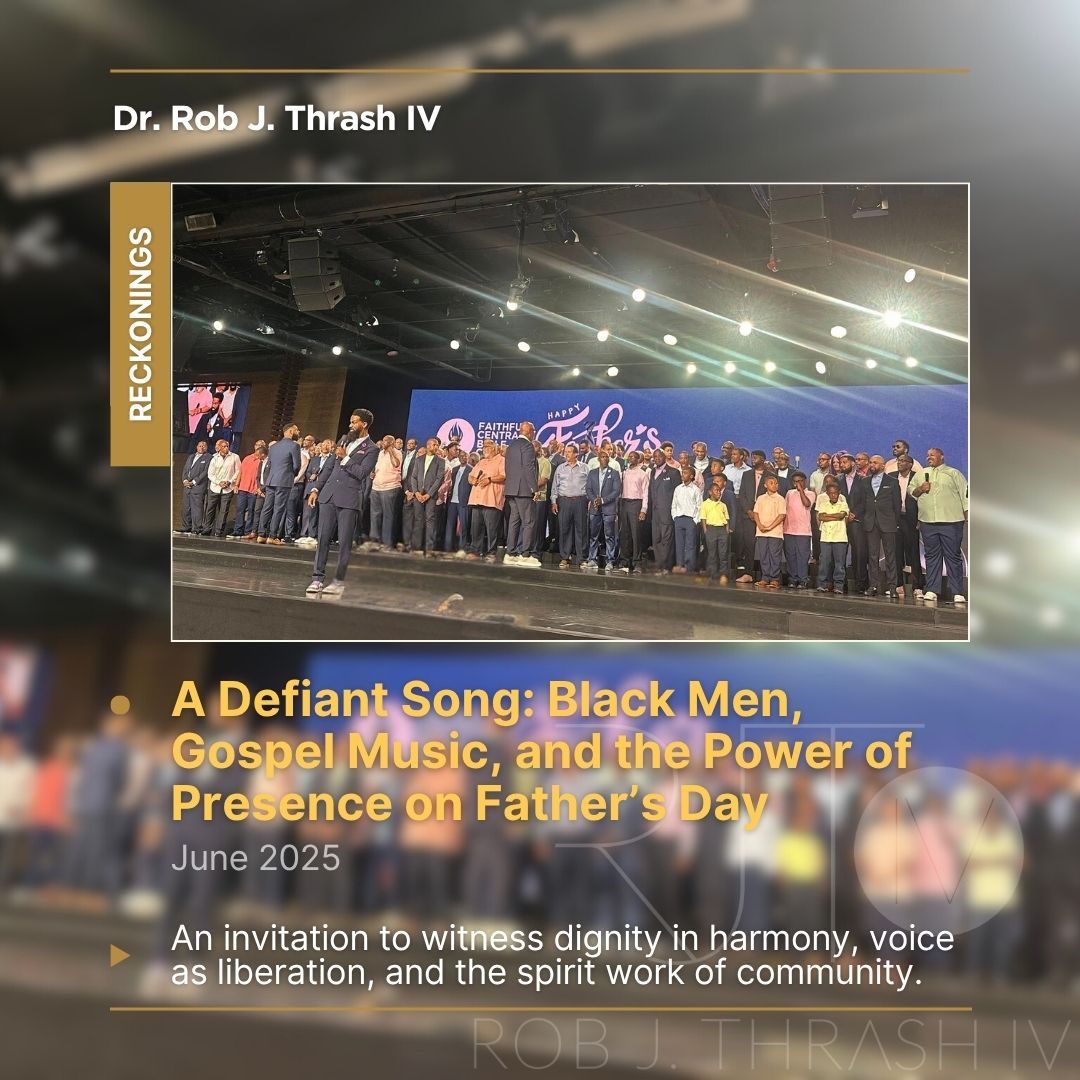
In a year marked by political erasure, cultural silencing, and the calculated undermining of Black identity, I stood among nearly 100 men on the platform of Faithful Central Bible Church in Inglewood, California, and took part in something profoundly radical: we sang.
It was Father’s Day, and the FCBC Men’s Choir stood not just as a musical ensemble but as a living, breathing counter-narrative to everything dominant culture has said and continues to say about Black men. From the youngest child voice to the seasoned baritone of elders, this choir was a mosaic of Black boyhood, fatherhood, manhood, and brotherhood (intergenerational and unapologetically loud). We sang with joy. We sang with conviction. And we sang the truth.
At the heart of this experience was Gospel music, that sacred sound born from sorrow and triumph, shaped by sanctified hands in moments of reflection, and passed down from generation to generation like a holy inheritance. Within the Black church, Gospel music is not performance; it is testimony. It has long served as a mechanism of healing and empowerment, of naming pain and praising through it, of drawing near to God while affirming the dignity of Black life.
This Father’s Day at Faithful Central, the weight of legacy did not need to be announced. It was present in the stillness before the downbeat, in the quiet nods between men who had walked long roads to be there. Under the guidance of Kurt Lykes, the Men’s Worship Team opened the service not with performance, but with intention. As the choir offered Rev. Timothy Wright’s We’ve Come to Praise and later Pastor John P. Kee’s I Made It Out, the sanctuary did not erupt. It responded. The music did not crash into the room; it settled over it like memory, like healing. And when Nelson Jackson laid his fingers gently across the Hammond B-3 Organ and the sanctuary recognized the opening line of Dr. Margaret Douroux’s If It Had Not Been for the Lord on My Side, no one had to be told what to feel. The sound moved through the room with the quiet authority of something sacred. Something known.
But beyond the music itself was the power of proximity. In the weeks leading up to the service, men who had previously only nodded to each other in passing began to share stories. Between run-throughs and harmonizing parts, we talked about journeys through faith, fatherhood, loss, healing, mentorship, and joy. The rehearsal room became a sanctuary within the sanctuary—a place where vulnerability and laughter flowed with equal ease. For many, learning the songs was secondary. The true ministry happened in the fellowship.
This gathering was not limited to elders. It made room for young boys, teenagers, and college-aged men. But their presence was more than symbolic. It was needed. It was holy. And while their voices joined in joy, they also carried quiet questions. About identity. About place. About whether there would still be room for them when the song ended. In a nation where young Black boys are so often viewed as threats or lost causes, their visibility in a space of power, praise, and purpose was nothing short of revolutionary.
The significance of such a gathering is magnified when viewed against the backdrop of American misrepresentation. Portrayed as absent, vilified as negligent, erased from narratives of care, the Black father has long been distorted. But data (and lived experience) tell another story. Among fathers who live with their children, Black fathers are the most consistently engaged in their children’s daily lives. Feeding. Bathing. Reading. Within the Family of Champions, we also recognize that there are nuanced experiences of Black fatherhood that cannot be reduced to statistics alone. Our Senior Pastor, Dr. John-Paul C. Foster, calls us into continuous growth, reflection, and accountability. That Sunday, the truth about Black fatherhood was not simply spoken. It was embodied. And throughout the Tabernacle, men of all ages, seated in pews and walking the aisles, stood as a collective force of love.
In a nation waging war on memory and truth, where books are banned and Black voices are policed, 100 men took the mic and chose another way. In their song, there was more than praise. There was breath. There was memory. There was the quiet defiance of men who refuse to be made invisible.
There is something liberatory, something deeply spiritual, about men—particularly Black and other marginalized men—lifting their voices in collective worship. In a society that punishes emotional expression in men and demands silence from the marginalized, Gospel music becomes both balm and blade. It heals, and it cuts through the lies.
This is not a celebration of a choir. It is a call. A reminder to every man who wonders if his presence in sacred space is necessary: it is. Whether or not you can carry a note, you carry a name. Whether or not you know the lyrics, your life is a testimony. Music ministry is not for the flawless. It is for the willing. Your voice is wanted.
On Father’s Day, in the heart of Inglewood, nearly one hundred men stood as a quiet chorus of memory and possibility. They did not sing for recognition or applause. They sang because something within them refused silence. Because the story of who they are (as fathers, brothers, sons, and believers) deserved space and sound. And in that space, something holy rested. A reminder that as long as breath fills our lungs and community holds our hands, praise will never be a solitary act.
