
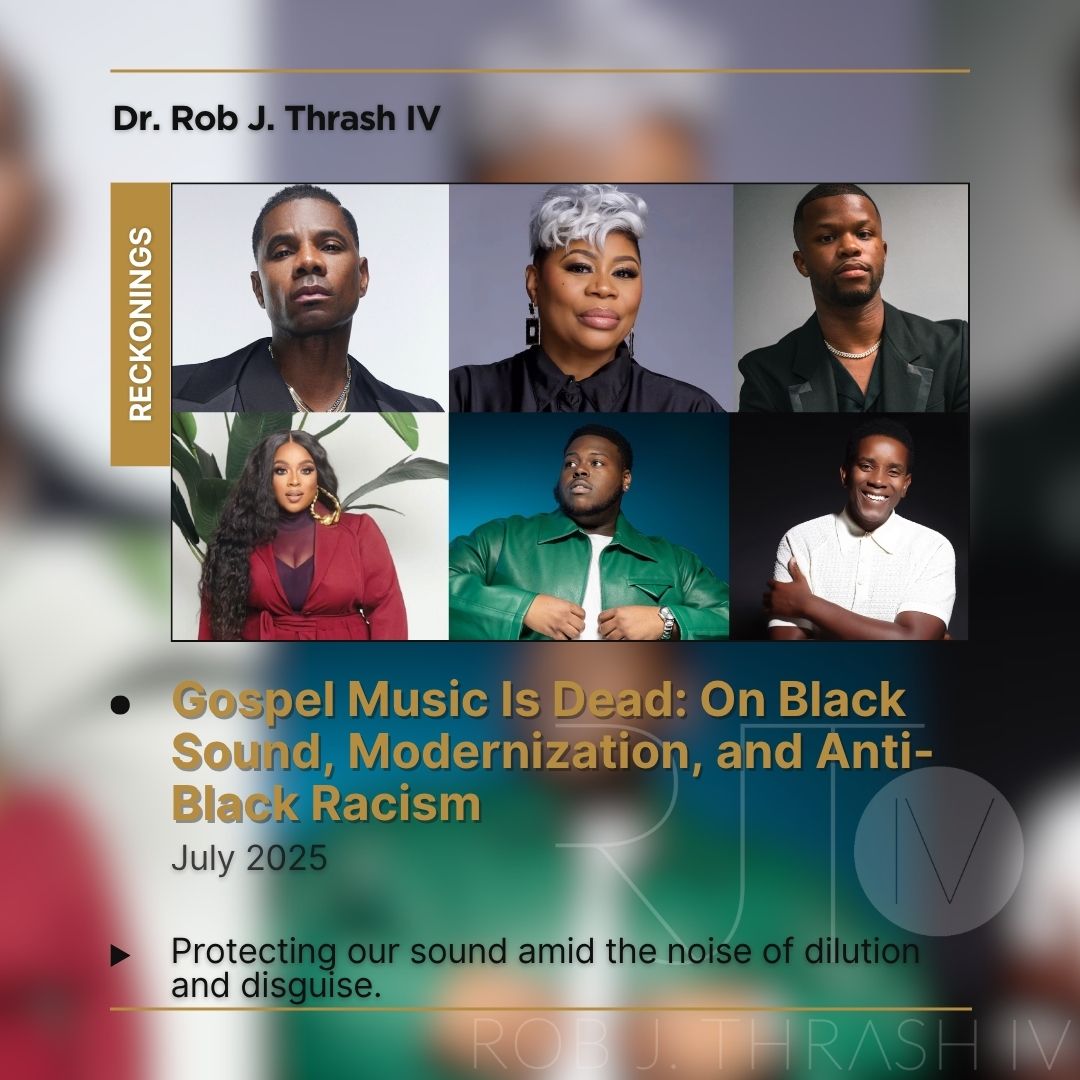
Gospel music is not dead. We know that because it is still doing what it was created to do: make room for praise, hold space for joy and sorrow, and declare the truth of a living God through the voices of a living people. It does not need to be softened, reshaped, or explained to matter. It does not need to mimic other sounds to maintain its power. It is enough, as it is, because the God who gave it to us has never stopped being enough.
Still, too often, we allow ourselves to be lured into a language of lack, as if Gospel music must be “revived,” “updated,” or “elevated” to remain relevant. But Gospel music has never been the problem. One of the great dangers in framing Gospel’s future is in doing so through the white gaze. The white gaze, as theorized in Black critical thought, is a way of seeing that centers whiteness as the standard. It measures the worth of Black expression against Eurocentric norms and strips cultural production of its context to render it more palatable, more marketable, more controllable. Under the white gaze, Black music must be explained, validated, or compared, lest it be seen as too emotive, too layered, too complex, too Black.
This is anti-Black racism at work. Not the overt kind we have learned to spot, but a quieter violence that disguises itself as taste, trend, or market appeal. It is the same force that historically discredited Black genius unless filtered through a white frame. When Black Gospel artists are asked to mute their emotional intensity, reduce their choir arrangements, or “clean up” their delivery for broader (whiter) audiences, it is not innovation that is being asked of them. It is compliance. Anti-Black racism thrives in these moments by denying the full validity of Black expression unless it is bent toward white comfort. And when that request is echoed by Black voices seeking proximity to power or platform, it becomes even more insidious.
In its most seductive form, anti-Black racism recruits Black voices to do its bidding. It finds a stage, offers a mic, and names them “representative.” But it still requires an audience. The question we must ask is: why do we continue to give it one? Why do we give our airspace to ideas that diminish us in the name of modernization? And perhaps even more urgently: why don’t we call to account those, especially our own, who hold space for and amplify these voices, knowing the harm they do?
When people talk about “elevating” Gospel music by referencing the aesthetics and staging of CCM, what they often mean is that Gospel must look less like Black church and more like white performance culture. But what birthed our songs is not what birthed CCM. The theological terrain, the lived experiences, the sonic theology, and the very breath behind Gospel are different. They are rooted in a people who, while historically disinherited by this nation, remained divinely sustained by God. We do not need to approximate whiteness to honor the holiness of our tradition.
Gospel music is not dead, but the spaces that once nourished it are under siege. Gentrification does not only change zip codes and rental prices. It rearranges soundscapes. The churches that once rang with the cry of the Hammond organ and the wail of a Sunday morning soloist are being replaced by “respectable” versions of praise: sanitized, stripped of testimony, and too polished to tell the truth. As I noted in The Song of Our Undoing: Black Sacred Traditions, Proximity to Whiteness, and the Lessons of Sinners, when you remove the cultural, emotional, and spiritual weight from the song, what remains is performance without power.
Respectability politics, a product of survival in anti-Black systems, taught us to believe that our salvation might be found in assimilation. That if we dressed right, spoke right, and sang right, we might finally be safe. But assimilation has always required too high a cost: our dialect, our joy, our rhythm, our testimony. And the church, our church, was never meant to be a stage for approval. It was and is a sanctuary for truth, for wailing, for praise that does not always hit the right note but always hits Heaven.
Anti-Black racism, in its most seductive form, recruits Black voices to do its bidding. It finds a stage, offers a mic, and names them “representative.” But it still requires an audience. The question we must ask is: why do we continue to give it one? Why do we give our airspace to ideas that diminish us in the name of modernization? And perhaps even more urgently: why don’t we call to account those, especially our own, who hold space for and amplify these voices, knowing the harm they do?
I become weary, spiritually, emotionally, and intellectually, when someone’s entire vision of Gospel’s future sounds like a Hillsong setlist with fog machines and floating lights. We have never needed the fog. And frankly, it is destroying our voices and worsening our asthma. But that is another article.
What we need is a re-centering. We need Maranda Curtis to reinterpret Andraé Crouch’s My Tribute, not as nostalgia, but as remembrance. A sonic altar that makes space for the elders who walked so we could sing freely. We need her to modulate into You Are Good with such freedom that we remember God’s consistent kindness while being ushered into the uncharted praise of right now. We need Jason White to arrange choir vocals that carry the urgency of a lead soloist and the communal strength of a congregation. Arrangements that honor the ingenuity of Cleveland, Hawkins, Walker, Dillard, Whitfield, Hall, Kee, and beyond. Not for replication but for revelation.
If we are to ensure the continued flourishing of Gospel music, we must commit to three things:
- Honor the Craft and the Calling: Excellence must remain our posture. Not for accolade or applause, but because God is worthy and the people deserve the best of what we have. This includes mentoring new artists in the theological and historical weight of Gospel, not just its sound.
- Create Spaces that Tell the Truth:We must reestablish platforms, within the church and beyond, that make room for Gospel music in its full expression. Not trimmed down to meet mainstream expectations, but raw, layered, unapologetically Black, and real.
- Preserve Without Apologizing: We do not need to explain our music in relation to anything outside of it. Gospel stands on its own. Our choirs, our solos, our tambourines, our modulations, our yes Lord’s, our oh my my my’s. They are not relics. They are roots.
We stand in our present, looking toward His greatness, while remembering His faithfulness throughout the generations. Gospel is not dead. But we must stop speaking of it like it needs to be renovated. It needs to be remembered. Restorative memory, not revisionist mimicry, is how we move forward.
And if you listen closely enough on a Sunday morning, between the key change and the altar call, you will still hear it. The sound of our survival. The sound of our becoming. The sound of our joy.
It is not dead. It is divine. And it is still ours.
