
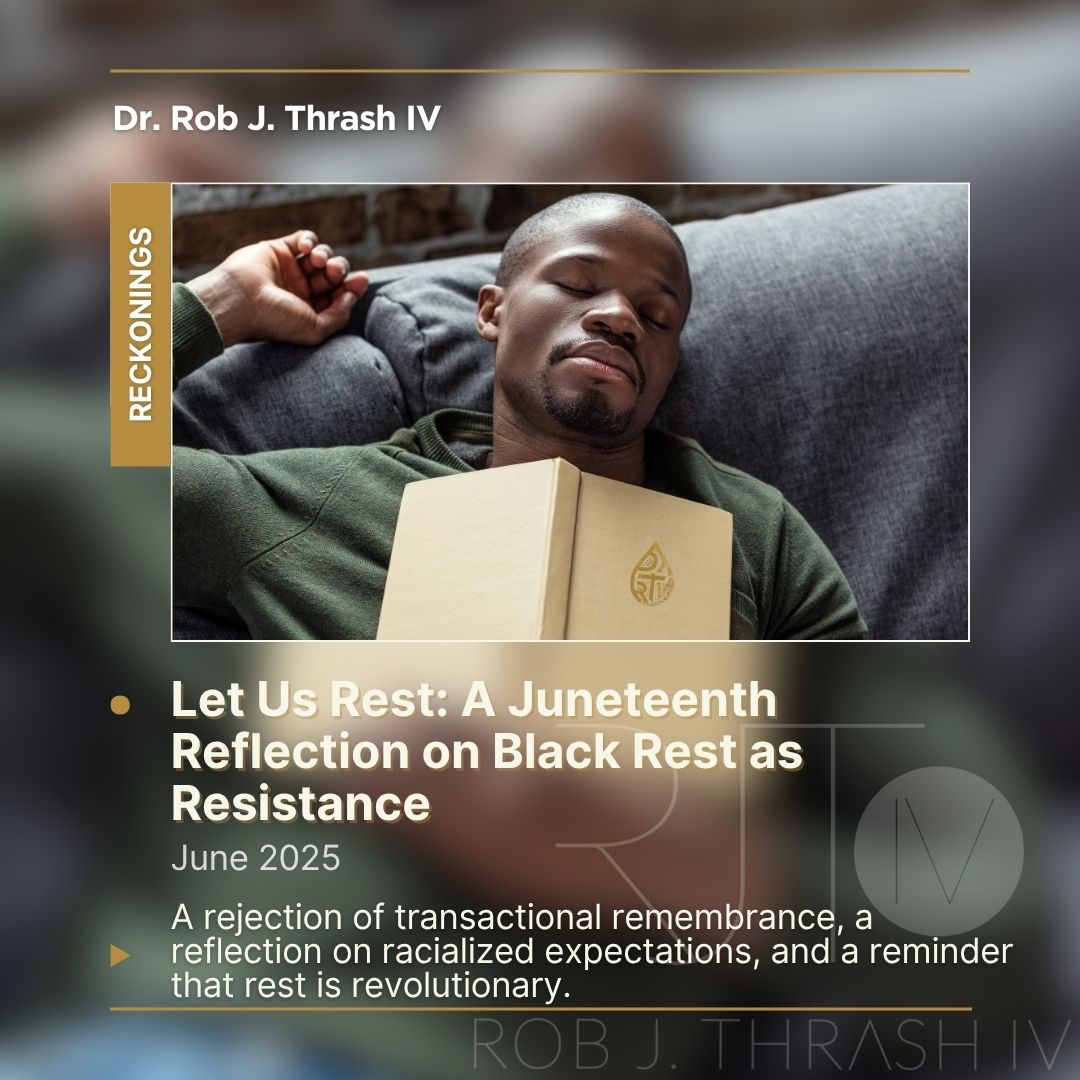
It is Juneteenth and I am going to rest. Not out of neglect. Not out of disengagement. But out of reverence. Because what is more sacred than choosing one’s body, one’s spirit, one’s breath after centuries of being told we are only as valuable as our labor?
There is a growing trend that feels familiar in its pressure and unsettling in its expectations. Each time a holiday like Martin Luther King, Jr. Day or Juneteenth arrives, the suggestion follows: go out and serve. Host a drive. Clean a park. Join a march. Do something productive. For many, especially those who do not live under the weight of systemic racism, these calls to action are symbolic ways to honor the past. But for Black folks, particularly those of us whose daily lives are already tethered to community work, equity labor, and the preservation of dignity in dehumanizing systems, these expectations feel like another layer of performance. Another unpaid shift in the name of resilience. Another refusal to let us be still.
On any given day of the week, we are expected to be educators of justice, spokespeople for healing, and translators of pain. We are asked to explain ourselves, justify our grief, prove our hope, and carry the unhealed wounds of a nation that has yet to fully admit it caused them. And even after all that, we are still expected to show up on a federal holiday and serve.
But what if we reimagined service not as motion, but as stillness? What if we honored King’s dream by dreaming? What if Juneteenth was not only a celebration of freedom, but an embodied practice of it? What if the greatest act of resistance was to close our laptops, silence our phones, and choose to rest not as a reward, but as a right?
To rest as Black people is to remember that we are more than what we do. It is to recognize that our ancestors did not survive ships and shackles so we could grind ourselves into dust beneath the weight of legacy. They survived so we could live. So we could love. So we could sit under the sun without explanation.
And make no mistake: this is not an indictment of those who choose to serve on these days. Community service is noble. It is necessary. As a man of Christian faith and a Life Member of Alpha Phi Alpha Fraternity, Inc., I believe deeply in service. It is how we show that we are brothers and disciples. It is the love we openly demonstrate to one another in a world that too often withholds it. But love (true love) also makes room for rest. Love says, “You have done enough for now.” Love says, “Sit down and be held for a while.” So while some may feel called to serve today, others may feel called to be still. And both are holy.
The culture of hyperproductivity, as I have argued, is a colonized one. It is rooted in extraction. It thrives on the idea that rest must be earned and service must be visible to be valued. But our ancestral traditions remind us otherwise. Rest is sacred. Silence is healing. Reflection is generational work.
On Juneteenth, I do not owe the world my body in motion. I owe my ancestors my stillness. I owe the children who will come after me the memory of a Black man who chose joy. I owe myself a moment to exhale. Because I, too, am somebody.
So this year, I reserve the right to rest. To be at ease. To slow the turning of this tired world and, if only for a moment, listen to the sound of my own breath. That, too, is liberation.
Let us rest. Let us remember. Let us regroup. The work will be there when we return. But today, may we be so free that we stop working to prove we are free.
And may no one—especially not those who love us—ask for more than that.
