
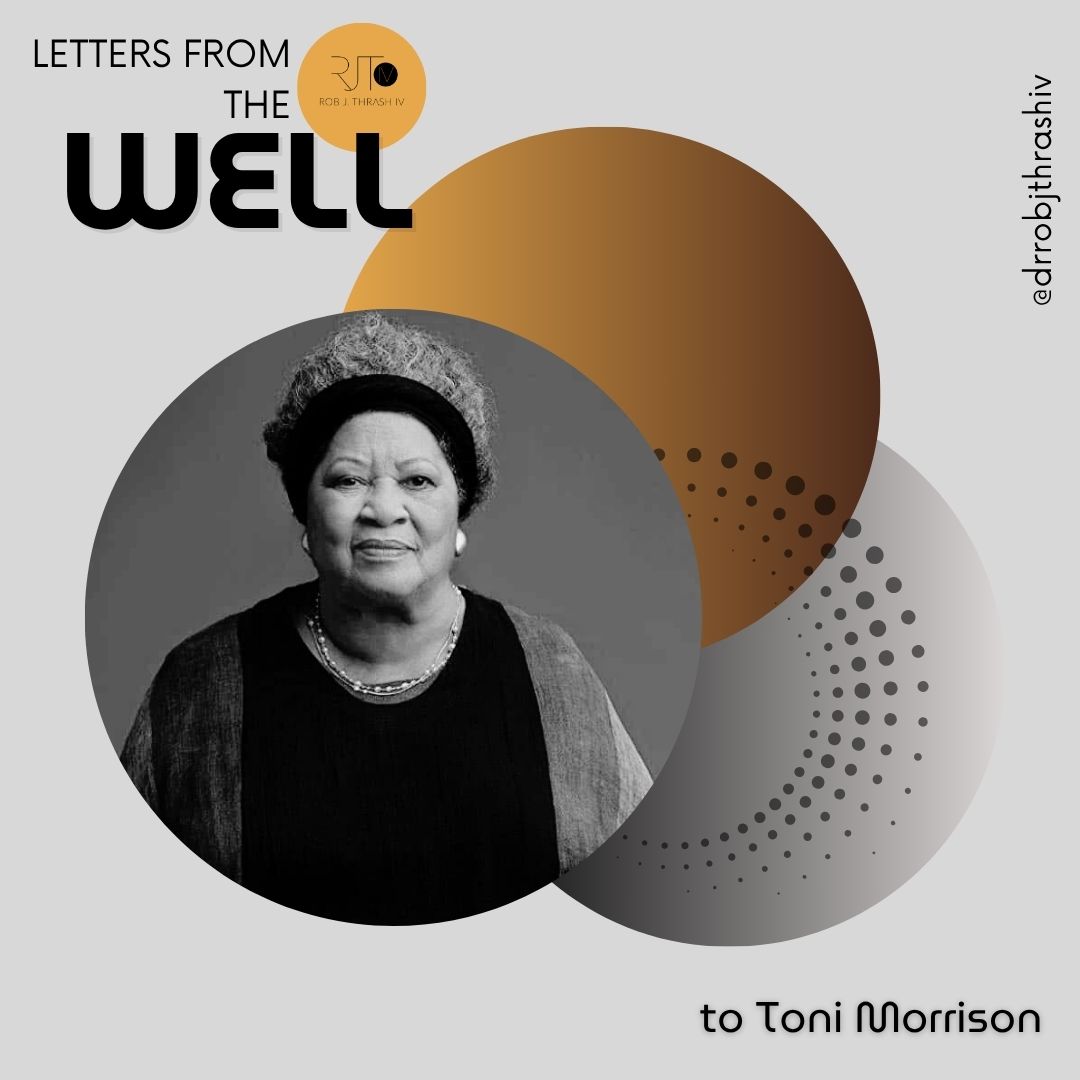
Ancestor Morrison,
I write to you with bowed head and lifted spirit, fully aware that this letter is not simply a note of thanks but a laying down of flowers at the feet of the one who made space for us to fly. You are no longer among us in body, yet your words remain alive: rooted, breathing, and bearing fruit. You walked this world with a clarity of purpose that transformed the literary landscape and cleared a path for those of us who now write, teach, and speak with our full Black selves intact. The freedom I have to center Black lives in my work, the boldness with which I name our joy, our trauma, our brilliance—none of it is incidental. It is the fruit of your resistance.
I am not a novelist. I do not claim the title of storyteller in the way you wore it, with elegance, precision, and audacity. I am a scholar. I am an educational practitioner. My work lives in schools, in professional development sessions, in policy meetings, and on frontlines where systems often try to smother our children’s light. And yet, because of you, I speak of Black life without dilution. I name Black pain without apology. I celebrate Black brilliance without seeking white approval. I walk into rooms knowing I do not need to make myself smaller. You gave us that kind of permission.
You wrote with the audacity of one who knew that Blackness was not deficit but depth. “You wanna fly, you got to give up the shit that weighs you down,” you wrote. And you taught us how. Not just through your fiction, but through the way you carried yourself in interviews and lectures (never pandering, never translating). I have read your novels and essays time and again. I have returned to Beloved when I needed to grieve. I have returned to The Bluest Eye when I needed to rage. And I return to Song of Solomon when I need to remember how to soar. Those final lines, “If you surrendered to the air, you could ride it,” live in my marrow. They remind me that freedom is both the cost and the reward of telling the truth.
What strikes me most, Ancestor Morrison, is that the ground I now walk on (the space I move through so freely) was once soil you had to break open with your bare hands. It was not always possible to write or speak to Black people without interference. It was not always safe to speak the full truth of our experience. But you insisted on it. You centered us when the world tried to erase us. You wrote for us, to us, about us, and you never looked over your shoulder. That stance alone was a revolution.
I often remind myself that my ability to speak plainly, powerfully, and lovingly about Black identity in the public square is because you refused to perform. You refused to translate. You said, “I stood at the border, stood at the edge and claimed it as central. Claimed it. And let the rest of the world move over to where I was.” That singular act shifted the literary world, yes, but it also shifted our cultural imagination.
So now, in my role as a Black educator and scholar, I carry that legacy forward. I no longer flinch when asked to explain our complexities to those who refuse to do their own learning. I no longer dim my voice in meetings where policy is being shaped. And I no longer worry about centering white comfort. That is your legacy living in me.
Bernice McFadden carries you. Robert Jones, Jr. carries you. Phillip B. Williams carries you. Edwidge Danticat carries you. Ta-Nehisi Coates carries you. And I carry you too. Not in mimicry, but in honor. Not to be you, but to continue what you made possible.
I count myself among those you raised through language. You showed me that theory and practice are not separate when the work is done with love. You showed me that literature can be liberation. That telling the truth, especially when it is about us, is sacred labor.
Thank you, Ancestor Morrison. Thank you for carving out a space where I could be fully Black, fully brilliant, and fully bold. Thank you for resisting what needed to be resisted, so that I could build what needs to be built.
You flew, and because you did, we now know how.
With all my radical love and eternal gratitude,
Dr. Rob J. Thrash IV
