
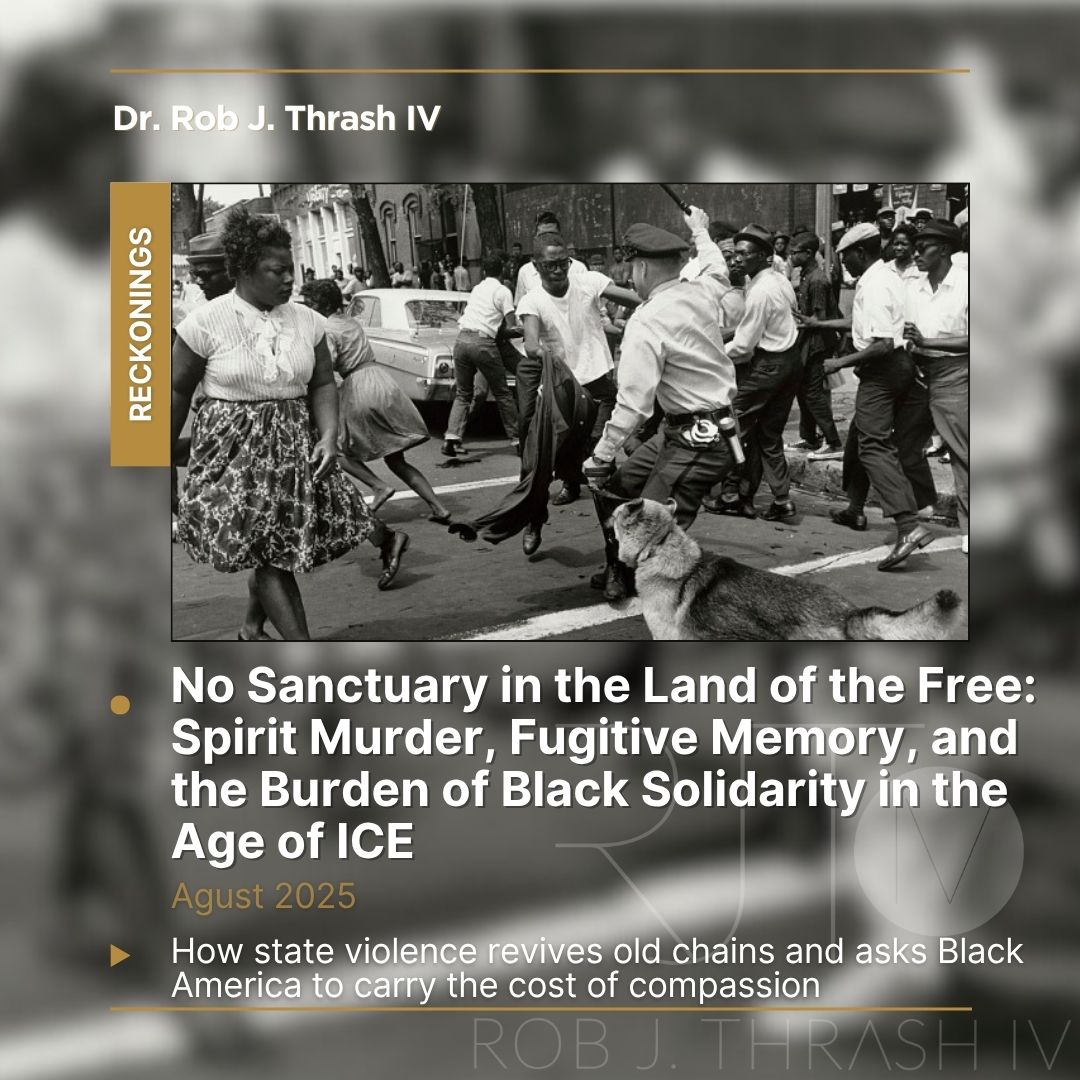
Across the United States, immigration enforcement raids are intensifying. Families are being separated at dawn, children are waking to find their parents gone, and communities are once again gripped by fear. While much of the public debate centers around legality and policy, what is unfolding is far more sinister: a renewed form of state violence that targets undocumented people while echoing the historical trauma of racialized control.
For Black Americans (many of whom stand in solidarity with their immigrant siblings), this moment is not just politically charged, but spiritually exhausting. It demands our attention not only because it is unjust, but because it perpetuates what Dr. Bettina L. Love defines as spirit murder: the systemic, often invisible, assault on dignity, safety, and humanity. This article draws a direct line between today’s ICE raids and the Fugitive Slave Act of 1850, challenging the expectation that Black people must always stand at the front lines of justice, even when our own well-being is on the brink.
To understand the violence of the present, we must first remember the logic of the past: the logic that turned fugitives into warnings and punishment into performance.
They knew what would happen if they were caught.
The ones who slipped away in the thick of night, soles bloodied by gravel roads and broken promises, knew that the cost of freedom might be their flesh. They ran anyway, because even the possibility of liberation whispered louder than the fear of pain.
But they weren’t the only ones captured.
So, too, were those who carried manumission papers in their pockets: proof of their freedom signed by white hands, sealed with legal authority. And so, too, were Black people who had never been enslaved, born free in the so-called free states. None of that mattered. Under the Fugitive Slave Act and the white supremacist machinery it upheld, Black skin became evidence of property. No explanation could shield you. No certificate could save you.
They did not return to the same field or the same chain. They were sent deeper: into the cotton fields of Mississippi, the sugar camps of Louisiana, the silence of captivity.
They returned to be made a warning.
Bodies whipped until they bled into the soil, backs opened like torn scripture. Ears cropped, cheeks branded, hope ripped from the bone. Some were sold further South, where sugar and cotton meant shorter lives and harsher deaths. Others were locked in crawl spaces or tortured in silence, starved until they forgot their own names.
These weren’t just punishments. They were rituals of spirit murder: acts designed not only to break the body but to extinguish the will. The aim was simple—kill the dream before it spreads.
I invoke the term spirit murder with intention. It is a concept powerfully advanced by Dr. Bettina L. Love (building on the work of legal scholar Patricia Williams) to name the systemic and racialized violence that robs Black and Brown people of dignity, safety, and belonging. Dr. Love speaks of how the educational system kills the spirit of Black children through surveillance, silencing, punishment, and erasure. I bring her framework into this moment because ICE raids (carried out with militarized force and justified through hate-filled rhetoric) are not merely policy decisions. They are state-sanctioned rituals of spirit murder, targeting undocumented families but echoing the same carceral logic used to control and dehumanize Black bodies for centuries.
We’ve been here before.
In today’s America, ICE raids descend on homes before sunrise. Children wake to the sounds of boots and shouting, of doors kicked open and hands bound. They watch their parents disappear into unmarked vans. And like the children of those once enslaved, they are left to make sense of a world where the state sees their family as fugitive, their safety as negotiable, their humanity as expendable.
Let’s be clear: ICE raids are not new. They occurred under President Obama, who deported more undocumented immigrants than any president in U.S. history. They occurred under Trump, with brazen cruelty and showmanship. And they are happening now. But something about this moment cuts deeper.
It’s not just the policy, it’s the rhetoric.
There is a new hostility in the language, a venom that frames people as invaders and communities as infested. It’s a deliberate narrative, drenched in fear and hate, designed to dehumanize the people who live next door (who work in our schools, care for our elders, build our homes, and love their children like we do).
And for many of us in the Black community, the grief is layered. We were not told that Kamala Harris would be different—we believed she would be. We held confidence in her stated vision: that immigration enforcement could be rooted in law and dignity. That families who built lives here (however complex their legal status) would not be hunted.
Instead, we find ourselves watching a familiar betrayal. The same pattern. The same playbook.
But the exhaustion we carry is not just physical, it is ideological. It is the recurring expectation that we, the descendants of the first fugitives, show up whole even when the nation refuses to acknowledge how it breaks us.
Black people are tired. Tired of saving a democracy that refuses to protect us. Tired of carrying the nation’s moral compass. Tired of watching policies we hoped would change become sharpened weapons instead.
And we are tired, too, of being asked to prove our solidarity by placing our bodies on the frontlines (as though our value is measured by our availability to fight someone else’s war). It is both unfair and violent to demand that we always show up in full force: to turn out, to protest, to donate, to organize, as if that is the only way our allegiance is valid. These expectations are not acts of unity. They are echoes of a long and bitter history of society extracting from Black people our labor, our brilliance, our creativity, our resistance, and our hope—without ever pouring back into us.
We know this is not just a Latino problem. We understand that immigrant justice is bound up in the freedom struggles of us all. But we also know that if we are not strategic about how we engage (if we do not preserve something for ourselves), we risk spiritual depletion so profound that recovery becomes another mountain we must climb alone. Because the truth is this: once we have poured out, once we have given all we have, there will be no institution rushing to fill us back up. There will be no emergency wellness plan for the Black folks who burned themselves out showing up for everybody else.
And so, we ration our presence. We protect our peace. We do not run dry for the sake of optics. We draw from the well (but we do so knowing it must be filled again). And it will be. We will become full again.
This isn’t apathy. It’s ancestral wisdom.
The parallels with the Fugitive Slave Act of 1850 are undeniable. That law deputized white citizens to act as enforcers of enslavement. It empowered them to capture, detain, and deliver Black people back into bondage without trial, without testimony, without truth. It nationalized white fear and forced everyone (North and South) into complicity.
And today? The state uses ICE agents and local police, tech surveillance and algorithmic profiling, to deliver Brown and Black bodies into detention and disappearance. The public is encouraged to report “suspicious” people. Employers are punished for hiring undocumented laborers. We have simply traded slave catchers for immigration officers and plantations for private detention centers.
This is what spirit murder looks like in the twenty-first century. The slow unraveling of safety. The criminalization of presence. The performance of law and order that leaves children traumatized, families destroyed, and entire communities hollowed out. Dr. Bettina Love’s concept of spirit murder gives us the language to name what the state would rather we internalize as inevitability (when in fact, it is brutality masked as policy). Spirit murder occurs when the government doesn’t just punish behavior—it punishes existence.
Still, we walk alongside our undocumented siblings (not because we are unbroken, but because we remember). We remember what it meant to be hunted. We remember what it meant to be named criminal by the very laws designed to protect others. And we remember that the true test of liberation is whether we fight for those whose suffering is not our own.
But solidarity must not mean sacrifice without reciprocity.
Black people are not America’s moral compass on demand. We cannot be expected to continually rally for the soul of a country that continues to wound ours. If we are to march, it must be with and not for. If we are to show up, it must be because our presence is met with shared risk, shared love, shared repair.
There is no sanctuary in a nation that builds cages instead of communities.
And yet, there is a power that remains.
It lives in the memory of those who ran, even knowing they might be returned. It lives in the courage of those who smuggled freedom under floorboards and in folded maps. It lives in the child who dares to smile even as the door closes behind their father.
It is the power to name what is happening—not as policy, but as violence. Not as enforcement, but as spirit murder.
And in naming it, we begin the long work of undoing it.
