
So when you enter those places of trust, or power, dream a little before you think, so your thoughts, your solutions, your directions, your choices about who lives and who doesn’t, about who flourishes and who doesn’t will be worth the very sacred life you have chosen to live. You are not helpless. You are not heartless. And you have time.
– Toni Morrison
To understand the work I do is to understand the soil from which I come. I was raised in Inglewood, California, in a home shaped by prayer, Black brilliance, and the unwavering belief that love could be a strategy for survival. That belief was not born of naïveté. It came from watching my father, a pastor of more than three decades, serve faithfully while bearing the weight of an entire community’s hopes. It came from my mother, who made holy out of ordinary and modeled the kind of care that never needed permission to be revolutionary. My spiritual formation was not separate from my intellectual formation. It was its foundation.
The work I do spans across many rooms and roles. I labor at the intersection of education, faith, community leadership, and cultural advocacy. I guide schools toward equity, facilitate healing-centered practices, write liturgies for liberation, and lead difficult conversations in rooms that rarely name harm. I teach, sing, write, grieve, and build. And I do it all because I know what it means to be held by a community that saw me before I ever had to explain myself. I also know what it means to walk into rooms where that kind of seeing is absent. I have spent more than two decades in educational, faith-based, and professional spaces, navigating structures not built with me in mind. From classrooms to boardrooms, from worship platforms to policy tables, I have carried with me the stories of my people, the power of our ancestral wisdom, and the clarity that we are not the problem. We are the well.
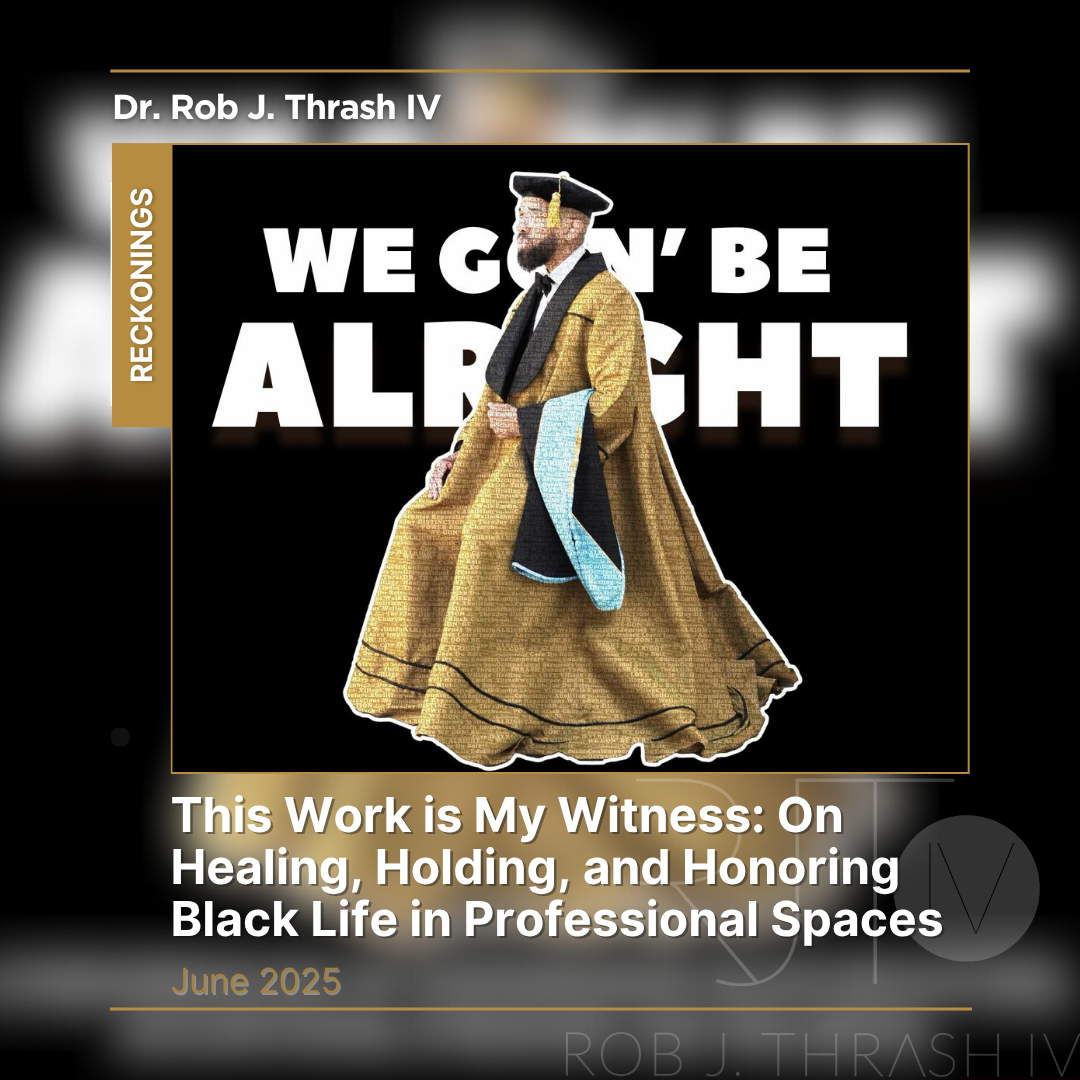
When I began my dissertation, We Gon’ Be Alright: A Phenomenology of Contemporary Black Educators, Occupational Stressors, and Wellbeing, as a doctoral student at the University of Southern California, I did so with the understanding that this research was not just academic. It was deeply personal. What I unearthed in that study confirmed what so many of us have felt but too often silenced: the labor of Black professionals is extracted while our needs are ignored. Our joy is demanded without regard for the cost. Our presence is tokenized, even as our ideas are co-opted or dismissed. We are expected to navigate policies that harm us, mediate conflicts rooted in anti-Blackness, and still show up as whole, smiling, grateful.
It is in that tension, between visibility and erasure, contribution and containment, that I situate my work.
I remember officiating the funeral of Dannie Farber, a young Black man whose life was marked by creative brilliance and sacred possibility. Standing at that pulpit, draped in both grief and responsibility, I found myself unable to move once the service ended. I sat alone in my car for what felt like hours, immobilized by the spiritual weight of holding so much for so many. That moment was more than exhaustion. It was a kind of soul-ache that many Black professionals know too well. We are often asked to carry the grief of our communities, the burdens of our institutions, and the expectations of our ancestors, all while being told that we are resilient. But there is a cost to that kind of constant holding. And that cost is rarely acknowledged in the systems that benefit from our endurance.
My scholarship is shaped by the brilliance of those who came before and those who walk alongside me now. Dr. Shaun Harper’s work on equity, racial literacy, and institutional accountability has been a guiding force. He has never flinched when it comes to naming systemic harm, and his scholarship continues to embolden my own voice. Dr. Christopher Emdin reminds me that there is power in the pentecostal. Teaching is not performance. It is praise. Dr. Shawn Ginwright’s call to move beyond trauma-informed practice to healing-centered engagement resonates through every training I facilitate. Dr. Bettina Love’s naming of “spirit murder” helps me make sense of why certain spaces feel so heavy, so hostile, so harmful. Dr. Tyrone Howard’s work gives me language to advocate for culturally grounded approaches to wellness. And Dr. Gloria Ladson-Billings continues to remind us all that equity is not a buzzword—it is a moral obligation.
In the tradition of Toni Morrison, I write not to explain us to anyone but to reflect us back to ourselves with care, complexity, and reverence. Like W.E.B. Du Bois, I believe in the gift of double consciousness. But I also believe we are due more than survival. We are due rest. We are due peace. We are due workplaces where we can exhale without shrinking.
That conviction is what gave rise to the Reckonings article series. This series is not simply a collection of essays. It is a sanctuary. It is where I bring my community into conversation with me about the questions we ask in the quiet: What does it mean to feel safe? What does justice look like in our institutions, our churches, our schools, our homes? How do we make room for our grief without apologizing for it? Reckonings is the space where my scholarship and spirituality meet my lived experience. It is a refusal to let silence be our only inheritance. Through these writings, I am extending an invitation—not to consume our pain, but to witness our truth, to hold our complexity, and to build with us toward something freer.
Racial trauma is not a concept to be theorized from a distance. It is lived reality. It lingers in the nervous system, settles in the chest, disrupts sleep, and distorts self-worth. And yet, institutions continue to ask Black professionals to do the labor of repairing the very harm being inflicted upon them. This is unjust. It is unsustainable. And it must be named plainly.
Still, I do not write from despair. I write from the deep well of faith that has sustained generations. I write from the sacred hush of communion services, the back pew testimonies, the stomp of choir risers on Sunday mornings. I write because I believe that Black professionals deserve more than survival. We deserve spaces where our multidimensional existence is celebrated, not punished.
That belief is why I train school leaders, coach emerging professionals, support worship leaders, and partner with communities. It is why I lift up joy as protest and creativity as liberation. It is why I believe in the radical potential of well-being. Not as an individual accomplishment, but as a communal act of resistance.
We are not disposable. We are not unworthy. And we are not finished.
What I carry into every space—whether I am preaching, presenting, singing, or strategizing—is the knowing that wellness is not a luxury. It is our birthright. And together, we can reclaim it. Not by fixing systems that were never designed for our flourishing, but by building wells where we drink deeply, rest often, and remind each other that we were never meant to carry this alone.
This is not just my work. It is my offering.
