
The new film Sinners lays bare, in chilling metaphor, a truth we have long felt but too rarely name. The white vampire, Remmick, who weaponizes music to control Black souls, represents more than a cinematic villain. He is the embodiment of systems that seek to co-opt and commodify Black expression. His fixation on Sammie’s voice (Sammie, a gifted Black musician and son of a pastor) mirrors the very dynamics unfolding in real churches today. Just as Remmick tries to reshape Sammie’s sound, modern worship spaces are increasingly tempted to contain and commercialize Black traditions, stripping them of their liberating, embodied, and communal roots. His method (to lull, to soothe, to hypnotize) echoes how whiteness has historically used culture, including music, to pacify Black resistance and redirect spiritual energy toward submission rather than freedom. Remmick is not merely pursuing a sound; he is pursuing its source. He wants control of the voice and the wellspring of Sammie’s gift, a voice that cannot be digitized or diluted. So he tries to possess it.
The vampire’s music in Sinners is not life-giving. It is life-stealing. It drains vitality while posing as beauty. It offers pleasure without deliverance. In this way, the film becomes more than horror; it becomes a prophetic mirror. It asks: whose songs are we singing, and for what purpose? Are we raising melodies that sustain our survival and honor those who came before us? Or are we unknowingly harmonizing with forces that drain our cultural and spiritual power?
I offer these reflections fully aware they emerge from my own lived experience. I also honor that there are ministers who find deep meaning in Contemporary Christian Music (CCM) and could write equally passionate reflections affirming its spiritual value. I am not arguing that CCM has no place in Black churches. That would be dishonest, especially since CCM songs have at times drawn me closer to God. Rather, I am sounding the alarm on the harm that occurs when Gospel music (the communal and liberatory sound that arises from our people’s history) is replaced, minimized, or muted in favor of a sonic standard divorced from our memory and prophetic voice. This piece is not written in condemnation, but in love: a love fierce enough to defend what must be protected, honored, and passed on.
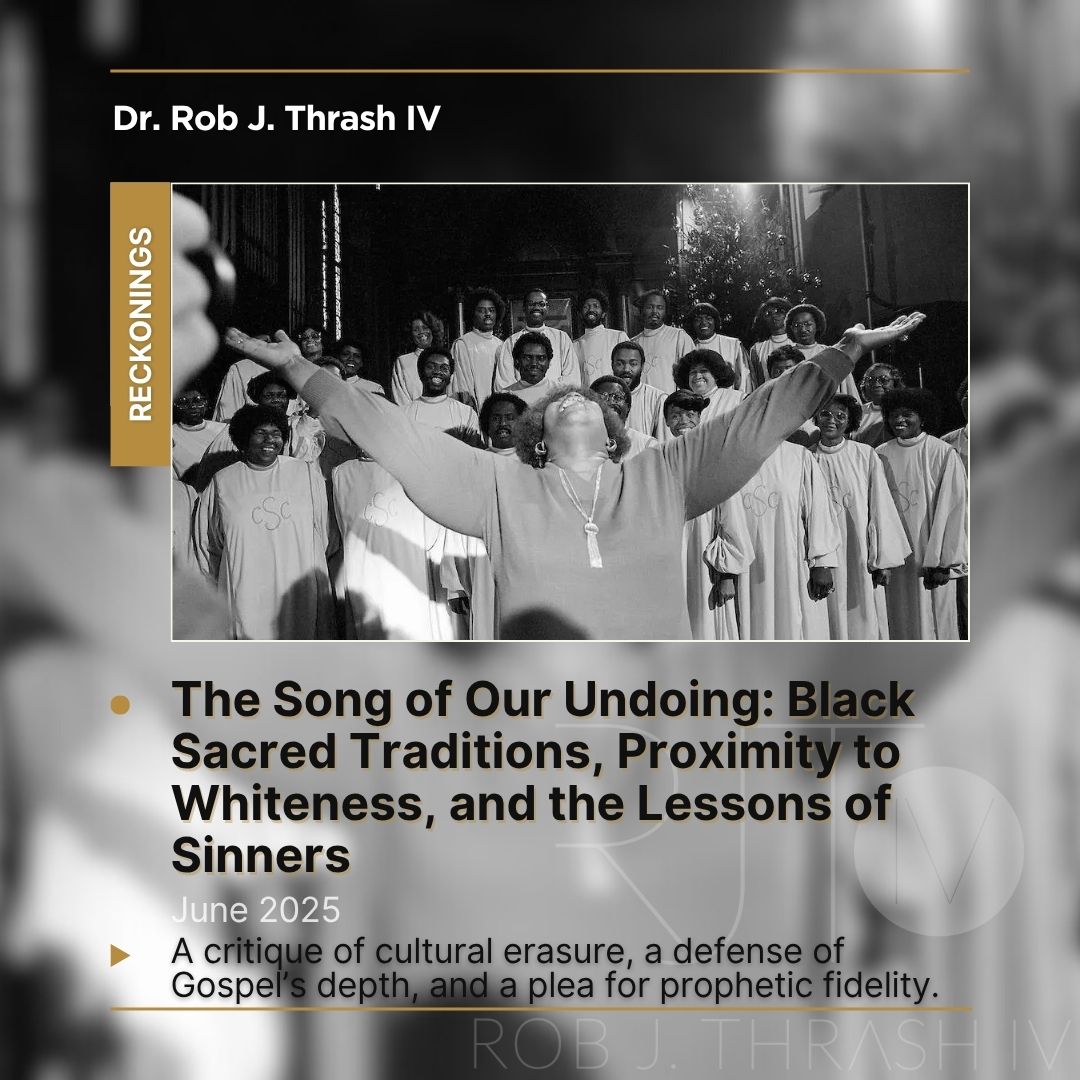
There is a sound that lives in our bones long before a choir robe is fastened or a Hammond organ hums. It is the sound of chains broken by song, of sorrow transformed into praise, of names whispered in prayer by grandmothers who never learned to read but knew God in every note. That sound, what we call Gospel, is not just music. It is memory. It is deliverance. It is how we have always known we were still alive.
Now, some are saying it is time to evolve. These voices come from church leaders chasing broader appeal, worship teams chasing industry trends, record labels prioritizing marketability, and congregants unconsciously shaped by a culture that equates whiteness with professionalism and progress. They argue for a sound that is sleeker, softer, more neutral, more palatable. CCM, they insist, offers a broader reach and a more polished tone. But inclusion is not the same as transformation. We cannot dress up assimilation and call it growth.
Because what some call progress, we recognize as erasure.
When the Black church begins to trade the Gospel sound for CCM (not as an addition but as a replacement), we must name what is lost. Gospel music is not an accessory to worship; it is the architecture of our survival. It was forged in fields, layered in hush arbors, shouted on brush arbors, refined in storefronts, and thundered through cathedrals built by those who had little but faith and a drum.
The call to bring back the choir is not simply a longing for vocal harmony. It is a cry for the return of Gospel music in its fullness: the harmonies that hold our history, the call and response that confirms our presence, the testimonies that erupt mid-song without permission. It is a call for the foot stomps and hand claps that become a liturgy written on the body. When we call for choirs, we are calling for a return to depth, a sound shaped by sorrow and affirmed through survival. We are calling for joy that knows its name only because it first encountered struggle.
This music holds our theology, our culture, and our healing. It welcomes grief, rage, hope, and celebration in a single breath. CCM, while sincere in its devotion, often lacks the weight of memory and the improvisational urgency that define the Black worship experience.
There are at least four dangers in this drift:
Cultural Dislocation and Erasure: Gospel music is a sonic archive of Black history. Its rhythms, call-and-response patterns, and creative brilliance are rooted in West African musical traditions and the spirituals of the enslaved. Replacing this with CCM’s more homogeneous and emotionally restrained terrain is to unwrite the story of a people who sang their way through bondage and beyond.
Spiritual Alienation: Gospel resonates not only in the ear but in the body. It invites full participation (hands raised, feet moving, voices lifted). In contrast, CCM often centers quiet, restrained experiences, which can spiritually disembody a congregation whose worship has long included all the senses.
Theological Dilution: Gospel names injustice, calls down deliverance, and offers hope in suffering. It is often Christ-centered and liberationist, grounded in eschatological joy and present-tense struggle. CCM, though worshipful, may lack the theological depth and cultural specificity required to speak to the realities of Black life.
Appeasement to Whiteness: The shift to CCM can reflect a desire to appear more palatable, marketable, or “universal.” To universalize whiteness is to displace our truth. This often mirrors the politics of respectability, which ask Black people to dim their brilliance for the comfort of the dominant gaze.
Erasure rarely announces itself with fanfare. It happens quietly, respectably, with subtle pivots. A new song here. A different worship leader there. A passing remark that Gospel is “too loud,” “too emotional,” “too Black.” Soon, the sanctuary sounds more like Hillsong than Hawkins. And the people who once felt seen in the sound begin to vanish with it.
We have seen this before.
Respectability politics, shaped by the trauma of systemic racism, taught us that if we dressed right, spoke right, and sang right, we might be accepted. But assimilation has always demanded too high a cost: our language, our joy, our rhythm, our truth. The church was never meant to be a stage for approval; it was meant to be a sanctuary for authenticity.
And still, we resist. We keep singing, dancing, testifying in tones that white supremacy cannot comprehend. From pulpits to protest lines, we proclaim that we are not striving for acceptability; we are striving for truth.
Yes, there is room for CCM. There is room for innovation and cross-cultural exchange. But let us never forget that the room was built on a sound that held us when nothing else did. Gospel is not a relic. It is a portal to our liberation. And any evolution that silences that sound is not progress. It is exile.
Let us also be clear: Gospel continues to shift toward CCM, but the reverse is rare. While many white CCM artists have adopted vocal runs, rhythms, and expressive styles pioneered by Black musicians, their music seldom becomes rooted in Black sound. They borrow style without centering the story. What we witness is not mutual transformation but cultural extraction. It is the adoption of Black creativity without the weight of Black suffering, Black theology, or Black memory. Gospel is asked to assimilate, while CCM remains untouched.
We do not grow by forgetting. We grow by remembering so deeply that our evolution carries the echoes of every voice that hummed a hymn through pain and shouted glory through despair. We were not saved by silence. We were saved by a sound.
I once served as a worship leader in a large Southern California church, sharing duties with a leader who preferred CCM. This church had deep Black Baptist roots. When I asked her what drew her to CCM, she admitted it stemmed from vocal limitations. Though she had grown up in church, she had not been immersed in the depth and complexity of Gospel. That moment revealed something profound: the sound of the church had shifted to accommodate a limitation. While compassion honors human limits, we must also discern when our sound is being shaped by circumstance rather than Spirit. The risk is subtle but real: adjusting our worship to fit what is convenient instead of what is faithful.
The lead pastor asked me to bring balance by anchoring CCM with the strength of Gospel. I accepted that call with joy. When members approached me after service, asking when I would lead again, I knew their longing was not for me. It was for what Gospel makes possible. They were craving connection, not performance. They were seeking an encounter with God through a sound that was both intimate and collective.
We must stay present. Loud. Unapologetically Black. Faithful to the sound that carried us.
Some ask: who is driving this shift toward CCM in Black churches? The answer is layered. It includes pastors seeking to grow their reach, worship trends shaped by white evangelical culture, marketing pressures, and internalized beliefs that whiteness is the standard of excellence.
Others ask: how do we know when CCM is included versus when it replaces Gospel? The answer lies in intention and frequency. When Gospel becomes the exception rather than the norm, when its presence is seen as outdated, that is not inclusion. That is erasure.
In multicultural or predominantly white spaces, where CCM dominates, the question becomes one of agency and belonging. Are Black worshippers invited to bring their voice, their rhythm, their testimony? Or are they expected to adjust, to fit, to silence? True worship welcomes full humanity. Assimilation demands selective silence.
Coexistence is possible. But it must be intentional. It cannot flatten Gospel’s power. It must make room for multiple expressions of reverence without erasing the distinct theological and cultural genius that Gospel embodies.
To those who call this mere preference, I say this: it is not about taste. It is about truth. Gospel music is more than a sound. It is a survival strategy, a theological map, an altar call in the wilderness.
This tension is personal. CCM often feels hollow to me, not because it does not name Jesus, but because it does so from a posture disconnected from the memory and legacy that Black people have carried for centuries. Long before slavery, Africans called on the name of Jesus. They sang His name in rhythms and melodies that made their way across oceans and time. Gospel music may have been born in North America, but it carries the pulse of Africa: the call and response, the layered rhythms, the urgency that refuses to let suffering speak the final word.
Gospel calls on Jesus with fire, tenderness, and defiant hope. It is not the name alone that matters. It is the spirit behind the name, the embodied faith of a people who have clung to the cross not as metaphor, but as lifeline and proclamation.
There are moments when I select CCM songs. Yet I always feel a tug to bring the song home: to insert call-and-response, to ask the band to add Gospel chords, to shift the rhythm toward our tradition. These gestures are more than style; they are reclamation. They are reminders that what we sing matters less than how we embody it and whether it reflects the river of memory we stand in when we open our mouths to praise.
What Sinners exposes is something I have long known. When worship loses its roots, when it seeks whiteness as its audience rather than God, it ceases to be worship. It becomes spectacle. It becomes seduction. It becomes a tool of spiritual disinheritance.
But there is another way. There has always been another way.
It is the way of elders who could call down heaven with a hum. The way of congregants who danced because the Spirit moved, not because it was scripted. The way of a people who, even under lash and law, declared, “We are somebody. We are God’s beloved. We will not be consumed.”
So in the face of dilution and disconnection, I do what our people have always done: I remember. I reclaim. I rejoice.
Our music is not entertainment. It is emancipation. It is covenant. It is the living memory of a God who sides with the oppressed and a people who refuse to die quietly.
What now? We begin with honest questions. Worship leaders, pastors, musicians, and congregants must ask: What shapes our choices? Are we choosing based on the Spirit or on silent aspirations to be accepted? Are we building altars or stages? Bearing witness or blending in?
Let us not wait until the sound is gone to recognize what it gave us. This is not about nostalgia. It is about fidelity. Gospel music is not a preference. It is a story sung aloud. It is sound theology, cultural witness, and prophetic resistance. It is the soundtrack of our becoming.
